- Area, from 386,000 m² (English Wikipedia)
- 38.6 ha
- When the park was built
- 1888 to 1894
- Height of Torre Branca
- 108.6 m
What Parco Sempione is
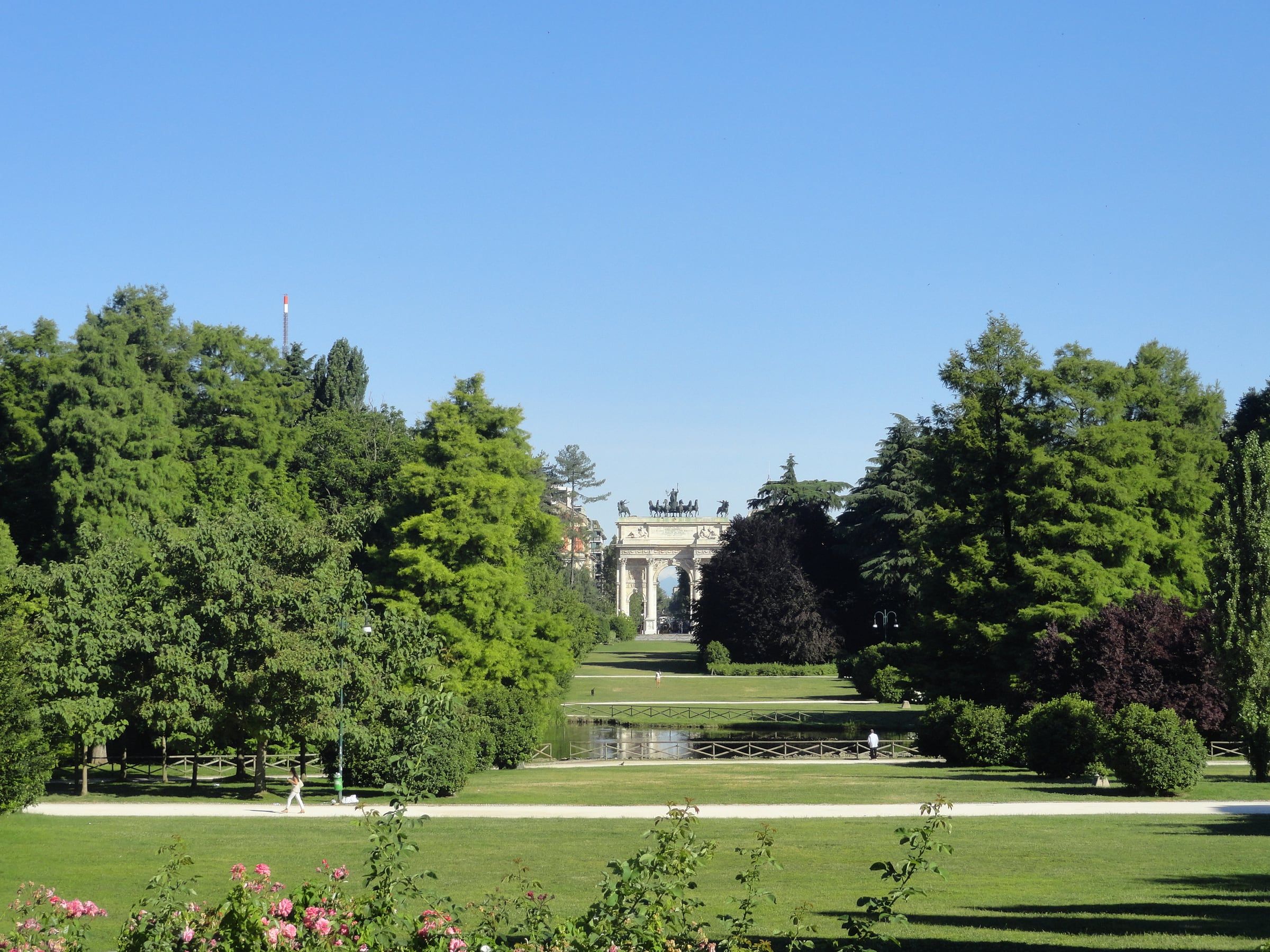
Parco Sempione is the big city park on the far side of Sforza Castle. If you have just finished the museums, it is the easiest way to spend a slack hour: grass, trees, benches and a few buildings worth a look. There is no entry charge to walk in.
English Wikipedia gives its area as 386,000 square metres, which works out at about 38.6 hectares. It describes the park as fully fenced. We found no opening hours for the park in the sources we checked, so look for signs at the gates on the day.
A short history of the land
The land was not always a public park. The same Wikipedia article says the Sforza-era park here once covered over 300 hectares, far more than today. The modern park is a 19th-century creation. English Wikipedia says it was built between 1888 and 1894 to a design by the architect Emilio Alemagna, following the romantic model of English parks. That explains the winding paths and informal lawns rather than formal avenues.
The Arco della Pace
At the park’s edge stands the Arco della Pace, the Arch of Peace. It was designed by Luigi Cagnola. English Wikipedia says work began in 1807 under Napoleonic rule and was completed in 1838. Cagnola resumed work in 1826 but died in 1833, and Francesco Londonio and Francesco Peverelli finished it.
The arch stands in Piazza Sempione, next to the park. It is a good place for a photograph looking back along the lawn towards the castle. Wikipedia says the gate traces its origins to a gate in the Roman walls of Milan.
The Arena Civica
English Wikipedia places the Arena Civica on the north-east side of the park’s main lawn. We could not open a dedicated source for the arena, so we give no dates, capacity or event details here. Treat it as something to see from the lawn, and look up any events separately.
Torre Branca
Torre Branca is a steel-frame panoramic tower in the park. English Wikipedia says it was built in 1933 for the fifth Milan Triennial, designed by Gio Ponti with the engineers Cesare Chiodi and Ettore Ferrari. Its original name was Torre Littoria. Wikipedia gives its height as 108.6 metres, limited by a decree that no new building should rise above the Madonnina on top of the Duomo.
The same article says that on a clear day the top gives views of the Milan skyline, the Alps, the Apennines and part of the Po Valley. We could not check the tower’s own website, so we give no opening times or prices. Check them before you plan around the view.
The Triennale
English Wikipedia says the Palazzo dell’Arte was built from 1933 to a design by Giovanni Muzio, and that it is now the home of the Triennale di Milano. Triennial exhibitions began there in 1933. It is a design and architecture venue rather than a museum of old masters, so what is on depends on the season. Opening hours and ticket prices are on its own website, which we could not load, so we leave them out.
Other things in the park
The same Wikipedia article lists several more sights:
- the Milan Civic Aquarium pavilion, built for the 1906 International Exhibition
- the Fontana dell’acqua marcia, dated 1925 to 1928
- the Ponte delle Sirenette, inaugurated in 1842 and moved to the park in 1930
- a Giorgio de Chirico work called Mysterious Baths, dated 1973
You do not need to see them all. Most people wander the paths, look at the arch and head back.
Fitting it into your day
The castle courtyards are free to enter every day from 07:00 to 19:30, according to the City of Milan’s castle site. The museums, by contrast, are closed on Mondays. That makes a Monday a sensible day for the park, since the park does not depend on the museum timetable. Our visiting Sforza Castle page has the hours, and inside Sforza Castle explains what the museums hold.
For somewhere to go next, Brera is the district around the castle’s other side, and the Duomo and Galleria Vittorio Emanuele II are a short metro ride away. Our nearby page has the full list, and getting there covers transport.