How the castle is laid out
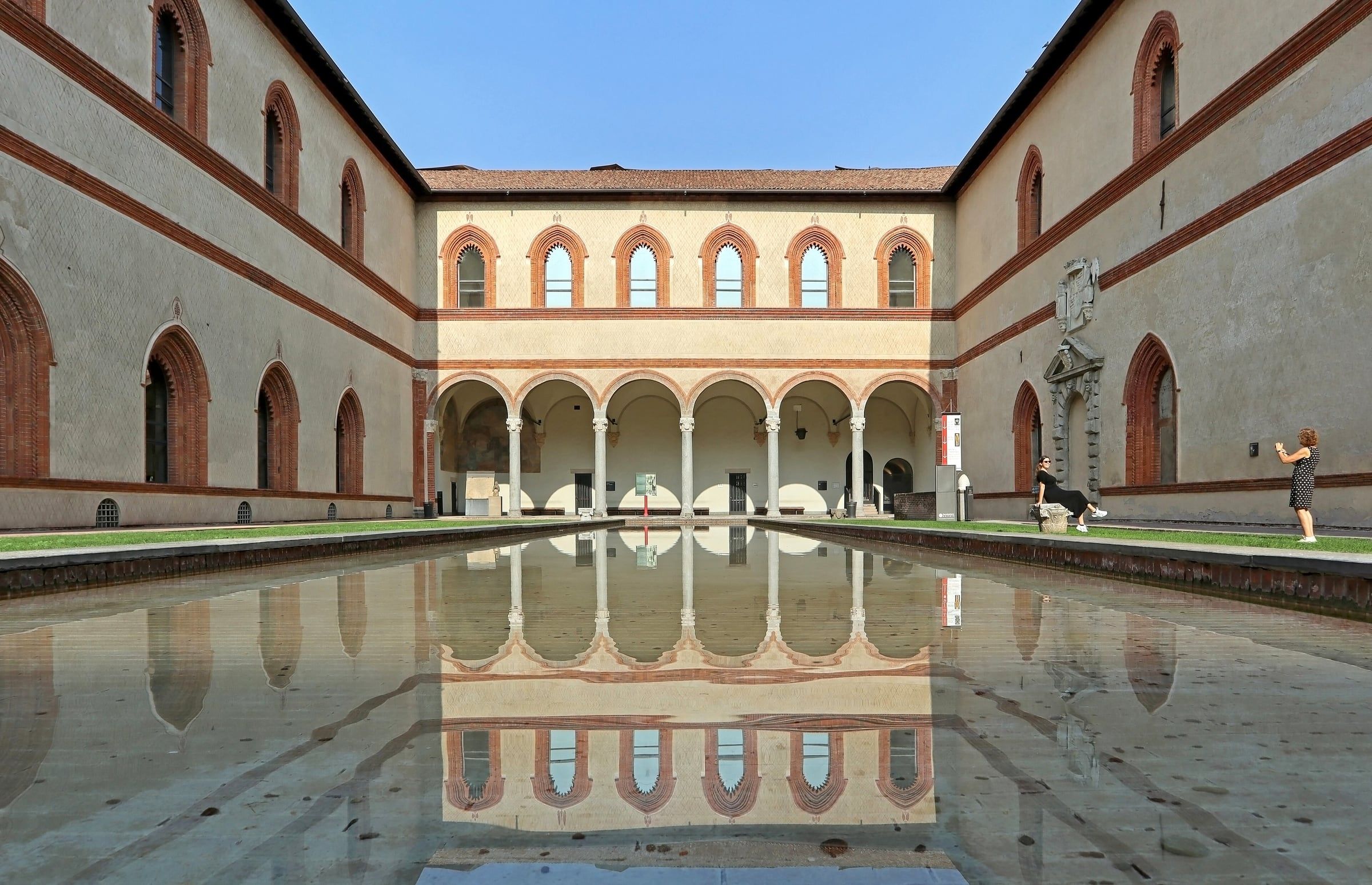
Sforza Castle is a brick fortress built around three linked courtyards, and the museums open off them. You enter by the main gate into the first and largest court. The castle’s own visitor guides call it the Cortile delle Armi. Many maps and guidebooks call it the Piazza d’Armi, a name that also described the vast parade ground outside the walls, about 700 by 700 metres, which later became Parco Sempione. See our Sempione Park page for the green space behind the castle.
Beyond the first court are the Corte Ducale, the old ducal residence with two loggias, and the smaller Cortile della Rocchetta, an inner stronghold with a Sforza coat of arms over its gate. The courtyards are free to walk through every day from 07:00 to 19:30 (checked October 2026). The museums need a ticket.
A short history helps. The Visconti began a fortress here in 1358, and Milan’s short-lived republic destroyed it in 1447. Francesco Sforza started rebuilding in 1450 as his family home and hired the architect Filarete in 1452 to design the central tower. That tower exploded in 1521, and the one standing now was rebuilt from 1900 to 1905 under the architect Luca Beltrami. Bombing in 1943 damaged the castle badly, and it was rebuilt for museum use after the war.
Which museum is where
The castle’s easy-read museum guides place the main collections like this:
- Corte Ducale, ground floor: Museum of Ancient Art.
- Corte Ducale, first floor: the Pinacoteca (paintings) and the museum of furniture and wooden sculpture.
- Cortile della Rocchetta, first floor: Museum of Musical Instruments.
- Cortile della Rocchetta, second floor: Museum of Applied (Decorative) Arts.
- Cortile delle Armi: the Rondanini Pietà museum.
The same guide counts eight museums in total. One museums ticket covers all of them, including the Ancient Egypt gallery, with one entry per section. Prices and hours are on visiting Sforza Castle.
Michelangelo’s Rondanini Pietà
This is the single best reason to buy a ticket. Michelangelo worked on the Rondanini Pietà from 1552 until his death in 1564, and Wikipedia says he was still carving it six days before he died. It is the last of three versions he made of the subject. The marble stands 195 centimetres tall.
The sculpture stood for centuries in a courtyard of the Palazzo Rondanini in Rome, which gives it its name. Milan now shows it in a purpose-built museum, inaugurated in 2015.
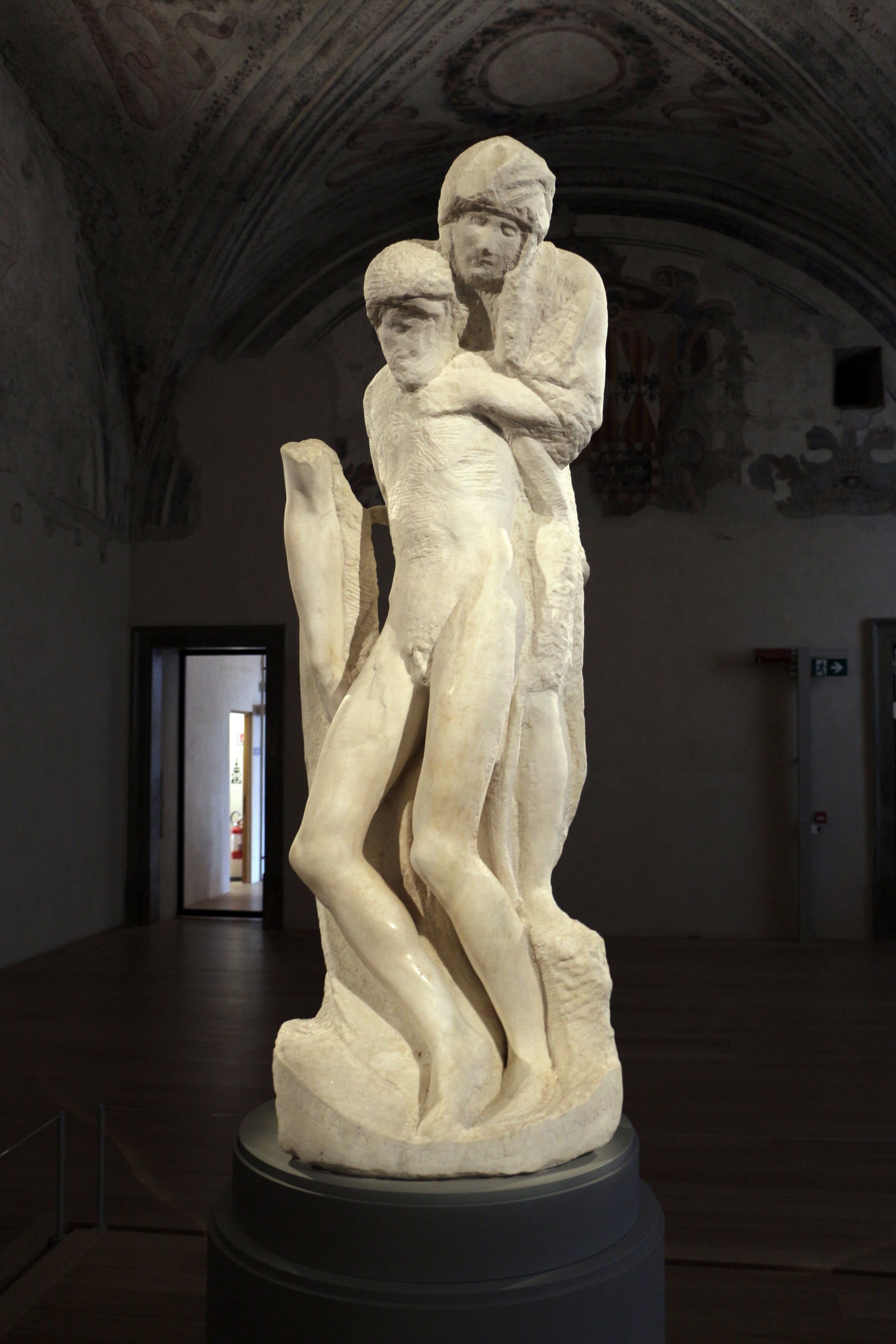
Allow 20 to 30 minutes. That is our own estimate, not an official figure. The guided tour listed on this page ends here.
The Sala delle Asse, Leonardo’s painted room
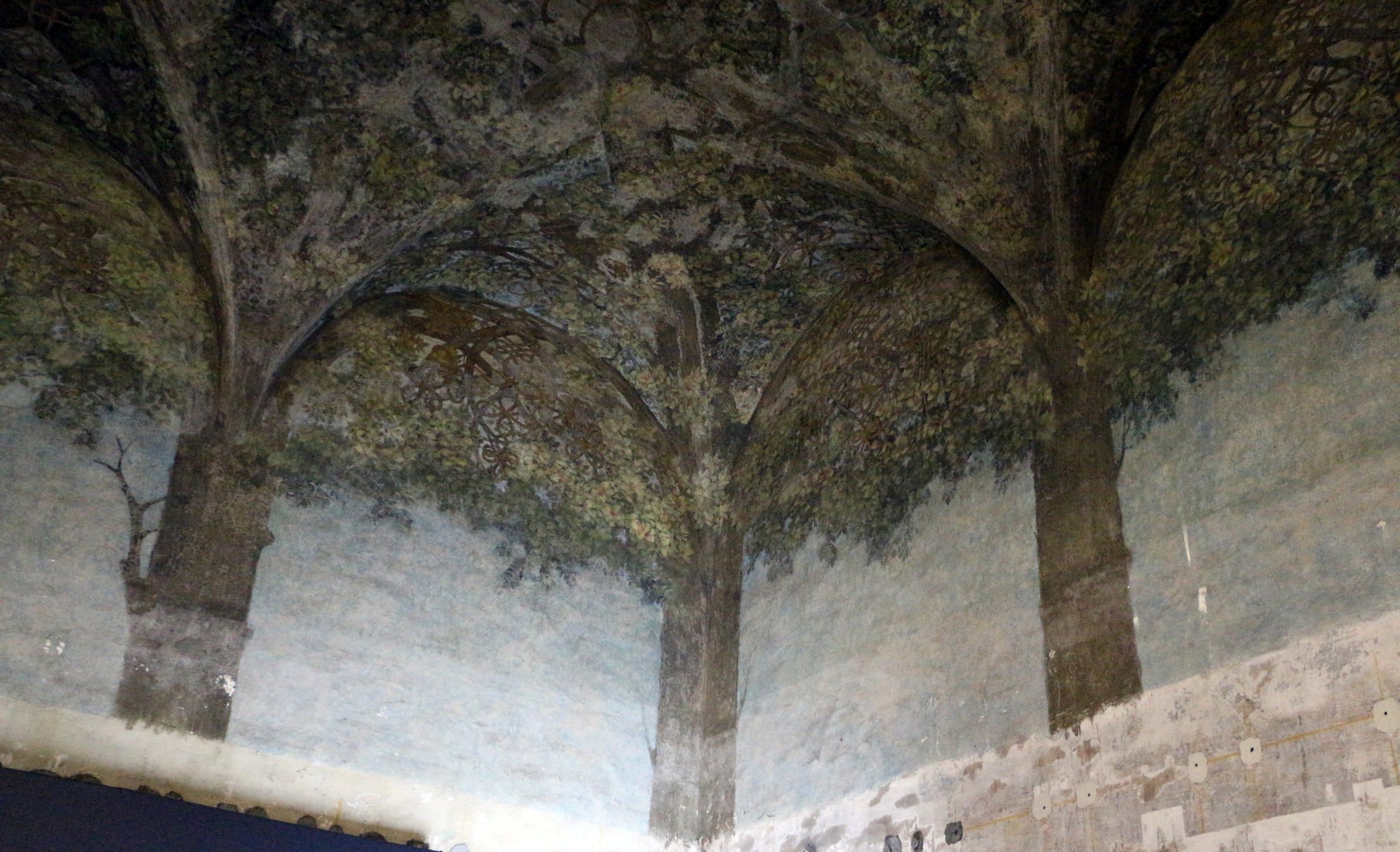
Leonardo da Vinci painted the Sala delle Asse in tempera on plaster around 1498 for Ludovico Sforza. A letter from the duke’s chancellor dated 21 April 1498 records the work. Painted tree trunks, leaves, fruit and knots cover the walls and vault, so the room looks like a canopy of trees. Ludovico’s coat of arms, with that of his wife Beatrice d’Este, sits at the centre of the vault.
The room has been restored three times. Beltrami’s team did the first in 1902, with bright colours. A second in the 1950s toned them down. A third began in 2012. A travel report says the room opened for guided visits from 7 February to 14 March 2026, then closed again for a final phase of work. When we checked in October 2026, the castle’s own website described the room as currently under restoration. It sits on the ground floor of the Corte Ducale as Room VIII of the Museum of Ancient Art, and the castle website offers four digital exhibitions about it in the meantime. Ask at the Infopoint whether you can see any of it on the day. The Museum of Ancient Art is worth the visit either way.
Museum of Ancient Art
The museum fills the ground floor of the Corte Ducale, in rooms where the Sforza family once lived. Several still carry decoration from their time, including the Sala dei Ducali, the Cappella Ducale and the Sala delle Colombine. Wikipedia lists an armoury and a tapestry room among the other highlights.
The star of Room 2 is the tomb of Bernabò Visconti. A statue of Bernabò in armour sits on horseback above a stone coffin raised on 12 columns. His family’s serpent emblem is on the armour, and two female figures beside the horse stand for justice and strength. Allow 45 to 60 minutes for the museum.
Pinacoteca
The picture gallery is on the first floor of the Corte Ducale. Wikipedia names Mantegna’s Trivulzio Madonna and works by Canaletto, Tiepolo, Foppa, Titian and Tintoretto. Individual works travel or go away for conservation: in October 2026 the castle’s notices page said Foppa’s Madonna del Libro was off display for maintenance, and that the Prehistory and Protohistory section was closed. The castle’s easy-read guide picks out Cesare da Sesto’s San Rocco polyptych in Room 21, painted during a plague. Allow 30 to 45 minutes.
Musical instruments, applied arts and Ancient Egypt
The Museum of Musical Instruments is on the first floor of the Rocchetta. Its collection grew from instruments bought from Natale Gallini and a gift from the Monzino family of lute makers. Cases group violins, guitars and flutes together, and one room holds keyboards.
The applied arts museum is one floor above, on the second floor of the Rocchetta, and the furniture museum is on the same floor as the Pinacoteca. The sources we could open say little about either, so treat them as optional. The Ancient Egypt gallery is covered by the same ticket, but the castle’s audioguide does not cover it.
The ramparts walk and underground routes
The Merlate Panoramiche is a walk along the castle’s battlements. It needs its own ticket and does not include the museums. It runs Tuesday to Sunday, with last entry at 17:00, and groups of up to 25 set off every 20 minutes with a member of staff but no guide.
Francesco Sforza’s outer defences were called the Ghirlanda: a wall protected by a water-filled ditch, with an underground passage by one gate. Guided routes through the Strada Coperta della Ghirlanda underground passage and along the ramparts are run by the concessionaire Ad Artem. Booking details are on the castle site. We have not checked their dates or prices.
If you are short of time
These are our recommendations, not official routes.
- One hour: the first courtyard, the Rondanini Pietà, then a walk through the Corte Ducale.
- Two hours: add the Museum of Ancient Art, and the Sala delle Asse if it is open.
- Three to four hours: add the Pinacoteca, the musical instruments and, if you like views, the ramparts walk.
The museums close at 17:30 and last entry is 16:30, so start by mid-afternoon at the latest. If you would rather have a guide, the castle runs walk-up museum tours at 11:00 each weekend, Saturday in English, for €20 including the ticket. Meet at the Infopoint at 10:45 (checked October 2026). The guided visit listed on this page includes castle and museum entry with a certified guide, in a small group, and lasts about 1.5 hours. If Leonardo is the draw, the Last Supper page explains how to book his mural.